images2832928529

Global Citizens , Digital Nomads……………an emerging opportunity for India

Recently Canada has launched its digital nomad policy . Earlier many European nations have also launched schemes for digital nomads .

Digital nomads are usually service sector workers who have remote working capability owing to good digital connectivity.

They usually are highly skilled , high earning individuals , abound with creativity and innovative potential. Their purchasing power is high , hence they add to economic activity .

In the current knowledge era , every nation wants individuals who act as a technological asset .

Bali ( Indonesia) , Italy , Greece ,Canada are emerging as favourite digital nomad hubs .

India can also tap into this opportunity of approx 5-6 million digital nomads .

The following steps can be taken in this regard :

1- Creating digital worker friendly zones ( particularly in hill stations and islands ) .

2- Ensuring reliable high speed internet connectivity.

3- safety and good infrastructure in terms of electricity and roads and green infra .

4- ease of taxation: taxation for digital nomads must be very friendly and facilitative.

5- to attract such talented fellows , special digital worker zones can be created. With on demand visa facilities, bare minimum taxation etc.

Even it can be considered that a transaction based tax is implemented rather than income based one .

As our nation is embarking on a transformative journey of becoming a developed nation , we need to adopt a leapfrog mentality.

Simple linear growth won’t suffice.

We need to have bold policies , with a high degree of flexibility and rapid decision making structures .

On the technological front , India has done wonders in those sectors where we had an audacious leapfrogging target .

simple computerization wouldn’t have yielded results.

Audacious quantum shifts like UPI ( unified payment interface) , Adhar , world’s largest drone survey program in the form of svamitva yojna etc have helped us in creating a mark in global development terrain .

Time is now to think big , act bigger and dream massive.
 

INDIA AND TUNISIA—- REDUCING DISTANCES

Facebook again provided an evidence of its strong candidature of being the latest dimension of society after press.

The group named “6th April” which ignited the sparks of revolution in Tunisia, got its expansion via facebook.

There is a mild buzz in Indian air, that “ does India also need a Tunisian revolution?”

Simple antagonistic logic is that if you can eradicate a malfunctioning government via democracy then why Indian people should follow the path of revolt.

But problem doesn’t end up here, in India people are in a state of choosing “ WORSE AMONG THE WORST” via their vote.

What Indian man can do if any of government, which he selects, is not even getting a satisfactory remark?

Only recycling those two or three bunches of politicians as our government, and being self-explanatorily glad is not a stand , which a citizen of such a great country deserves.

Second thing which goes in favour of revolution is voting percentage.

Now a days anyone can be our leader just via getting 27-28% of votes, which is a digit incapable to even pass a student.

These kind of problems are simply uprooting the belief of common man from democracy.

But a revolution like Tunisia can do no good in India because of its multiethnic, complex, giant social frame.

What we can learn from Tunisia is that if we people, we Indian common men want to change, then we can change.

There is nothing beyond the shaping capacity of our hands.

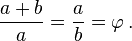
 \frac{a+b}{a} = \frac{a}{b} = \varphi\,.

DIVINE PROPORTION :: NO. WHICH FABRICATE NATURE(1.618)

In mathematics and the arts, two quantities are in the golden ratio if the ratio of the sum of the quantities to the larger quantity is equal to (=) the ratio of the larger quantity to the smaller one. The golden ratio is an irrational mathematical constant, approximately 1.6180339887.[1] Other names frequently used for the golden ratio are the golden section (Latin: sectio aurea) and golden mean.[2][3][4] Other terms encountered include extreme and mean ratio,[5] medial section, divine proportion, divine section (Latin: sectio divina), golden proportion, golden cut,[6] golden number, and mean of Phidias.[7][8][9] The golden ratio is often denoted by the Greek letter phi, usually lower case (φ).

The figure on the right illustrates the geometric relationship that defines this constant. Expressed algebraically:

 \frac{a+b}{a} = \frac{a}{b} = \varphi\,.

This equation has as its unique positive solution

\varphi = \frac{1+\sqrt{5}}{2}\approx 1.61803\,39887\ldots\, 
Two quantities a and b are said to be in the golden ratio φ if:

 \frac{a+b}{a} = \frac{a}{b} = \varphi\,.

This equation unambiguously defines φ.

The right equation shows that a = bφ, which can be substituted in the left part, giving

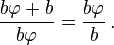
\frac{b\varphi+b}{b\varphi}=\frac{b\varphi}{b}\,.

Dividing out b yields

\frac{\varphi+1}{\varphi}=\varphi.

Multiplying both sides by φ and rearranging terms leads to:

{\varphi}^2 - \varphi - 1 = 0.

The only positive solution to this quadratic equation is

\varphi = \frac{1 + \sqrt{5}}{2} \approx 1.61803\,39887\dots\,
Leonardo da Vinci‘s illustrations of polyhedra in De Divina Proportione (On the Divine Proportion) and his views that some bodily proportions exhibit the golden ratio have led some scholars to speculate that he incorporated the golden ratio in his paintings.[29] But the suggestion that his Mona Lisa, for example, employs golden ratio proportions, is not supported by anything in Leonardo’s own writings.[30]

Salvador Dalí explicitly used the golden ratio in his masterpiece, The Sacrament of the Last Supper. The dimensions of the canvas are a golden rectangle. A huge dodecahedron, with edges in golden ratio to one another, is suspended above and behind Jesus and dominates the composition.[2][31]

Mondrian has been said to have used the golden section extensively in his geometrical paintings,[32] though other experts (including critic Yve-Alain Bois) have disputed this claim.[2]

The formula φ = 1 + 1/φ can be expanded recursively to obtain a continued fraction for the golden ratio:[46]

\varphi = [1; 1, 1, 1, \dots] = 1 + \cfrac{1}{1 + \cfrac{1}{1 + \cfrac{1}{1 + \ddots}}}

and its reciprocal:

\varphi^{-1} = [0; 1, 1, 1, \dots] = 0 + \cfrac{1}{1 + \cfrac{1}{1 + \cfrac{1}{1 + \ddots}}}

The convergents of these continued fractions (1, 2, 3/2, 5/3, 8/5, 13/8, … , or 1, 1/2, 2/3, 3/5, 5/8, 8/13, …) are ratios of successive Fibonacci numbers.

The equation φ2 = 1 + φ likewise produces the continued square root, or infinite surd, form:

\varphi = \sqrt{1 + \sqrt{1 + \sqrt{1 + \sqrt{1 + \cdots}}}}\,.

An infinite series can be derived to express phi:[47]

\varphi=\frac{13}{8}+\sum_{n=0}^{\infty}\frac{(-1)^{(n+1)}(2n+1)!}{(n+2)!n!4^{(2n+3)}}

Phi can also be related to itself using a geometric series:[48]

\varphi+1=\sum_{n=0}^{\infty}(1/\varphi)^n or
\varphi=\sum_{n=1}^{\infty}(1/\varphi)^n

Also:

\varphi = 1+2\sin(\pi/10) = 1 + 2\sin 18^\circ
\varphi = {1 \over 2}\csc(\pi/10) = {1 \over 2}\csc 18^\circ
\varphi = 2\cos(\pi/5)=2\cos 36^\circ.\,

These correspond to the fact that the length of the diagonal of a regular pentagon is φ times the length of its side, and similar relations in a pentagram