In mathematics and the arts, two quantities are in the golden ratio if the ratio of the sum of the quantities to the larger quantity is equal to (=) the ratio of the larger quantity to the smaller one. The golden ratio is an irrational mathematical constant, approximately 1.6180339887.[1] Other names frequently used for the golden ratio are the golden section (Latin: sectio aurea) and golden mean.[2][3][4] Other terms encountered include extreme and mean ratio,[5] medial section, divine proportion, divine section (Latin: sectio divina), golden proportion, golden cut,[6] golden number, and mean of Phidias.[7][8][9] The golden ratio is often denoted by the Greek letter phi, usually lower case (φ).
The figure on the right illustrates the geometric relationship that defines this constant. Expressed algebraically:
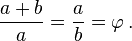
This equation has as its unique positive solution

- Two quantities a and b are said to be in the golden ratio φ if:
This equation unambiguously defines φ.
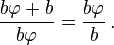
The right equation shows that a = bφ, which can be substituted in the left part, giving
Dividing out b yields
Multiplying both sides by φ and rearranging terms leads to:
The only positive solution to this quadratic equation is

- Leonardo da Vinci‘s illustrations of polyhedra in De Divina Proportione (On the Divine Proportion) and his views that some bodily proportions exhibit the golden ratio have led some scholars to speculate that he incorporated the golden ratio in his paintings.[29] But the suggestion that his Mona Lisa, for example, employs golden ratio proportions, is not supported by anything in Leonardo’s own writings.[30]
Salvador Dalí explicitly used the golden ratio in his masterpiece, The Sacrament of the Last Supper. The dimensions of the canvas are a golden rectangle. A huge dodecahedron, with edges in golden ratio to one another, is suspended above and behind Jesus and dominates the composition.[2][31]
Mondrian has been said to have used the golden section extensively in his geometrical paintings,[32] though other experts (including critic Yve-Alain Bois) have disputed this claim.[2]
- The formula φ = 1 + 1/φ can be expanded recursively to obtain a continued fraction for the golden ratio:[46]
and its reciprocal:
The convergents of these continued fractions (1, 2, 3/2, 5/3, 8/5, 13/8, … , or 1, 1/2, 2/3, 3/5, 5/8, 8/13, …) are ratios of successive Fibonacci numbers.
The equation φ2 = 1 + φ likewise produces the continued square root, or infinite surd, form:
An infinite series can be derived to express phi:[47]
Phi can also be related to itself using a geometric series:[48]
 or
or
Also:
These correspond to the fact that the length of the diagonal of a regular pentagon is φ times the length of its side, and similar relations in a pentagram


![\varphi = [1; 1, 1, 1, \dots] = 1 + \cfrac{1}{1 + \cfrac{1}{1 + \cfrac{1}{1 + \ddots}}}](http://upload.wikimedia.org/math/8/b/6/8b60ba0565a178cde9cc400bd6c253ab.png)
![\varphi^{-1} = [0; 1, 1, 1, \dots] = 0 + \cfrac{1}{1 + \cfrac{1}{1 + \cfrac{1}{1 + \ddots}}}](http://upload.wikimedia.org/math/2/5/9/259a0cfb6276d6df9f5a91b57d9683bd.png)





Leave a Reply